 PICULab Calc
0.1 mg/mL (1:10 000)
Pediatric intensive care · iPhone and iPad
Life-saving doses, first.
Set the weight once. PICULab Calc works out the drugs, tubes and shocks for the child, runs the Code Blue clock, and keeps 159 calculators, scores and criteria a tap away, each with its references.
App Store SOON
Contact us
159calculators
11categories
0data collected
PICUPATIENT
Edit
PATIENTPreschool childMale · 5 years
WEIGHT18kg
AGE5y
HEIGHT110cm
BSA0.74 m²
Clears 12 h after last edit
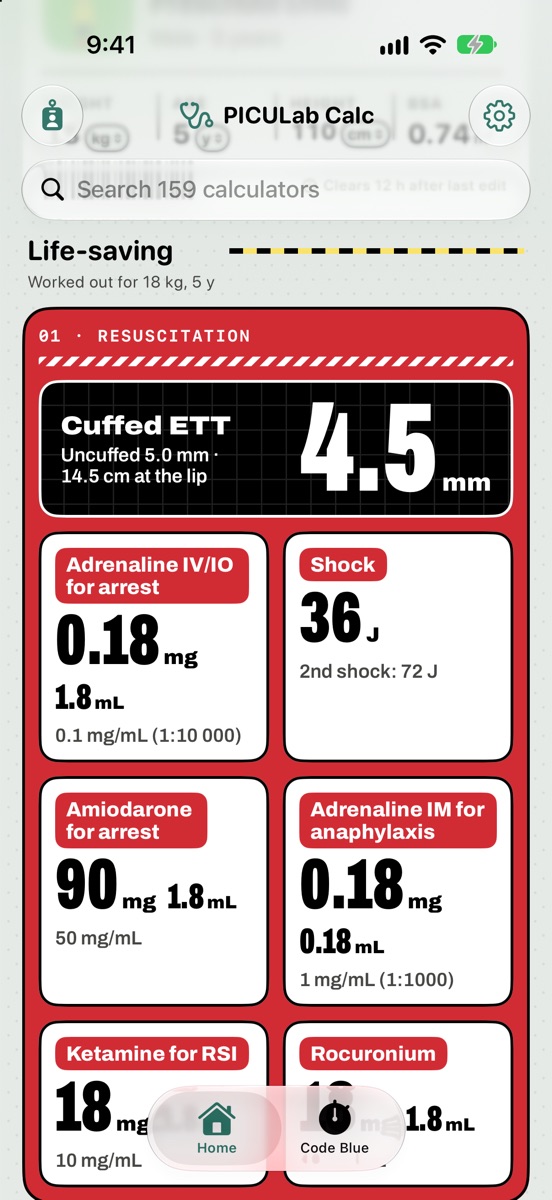
Life-saving
Worked out for 18 kg, 5 y
Once the weight and age are set, Home lists the numbers needed in the first minutes: tube size and depth, adrenaline, shock energy, amiodarone, RSI drugs, fluids, seizure doses and the normal vital signs for that age.
Each box opens its full calculator, with the formula, the notes and the source. Newborns get their own list, from the neonatal resuscitation guidelines.
Example values for an 18 kg, 5-year-old child. Check every dose against your local protocols.
01 · Resuscitation
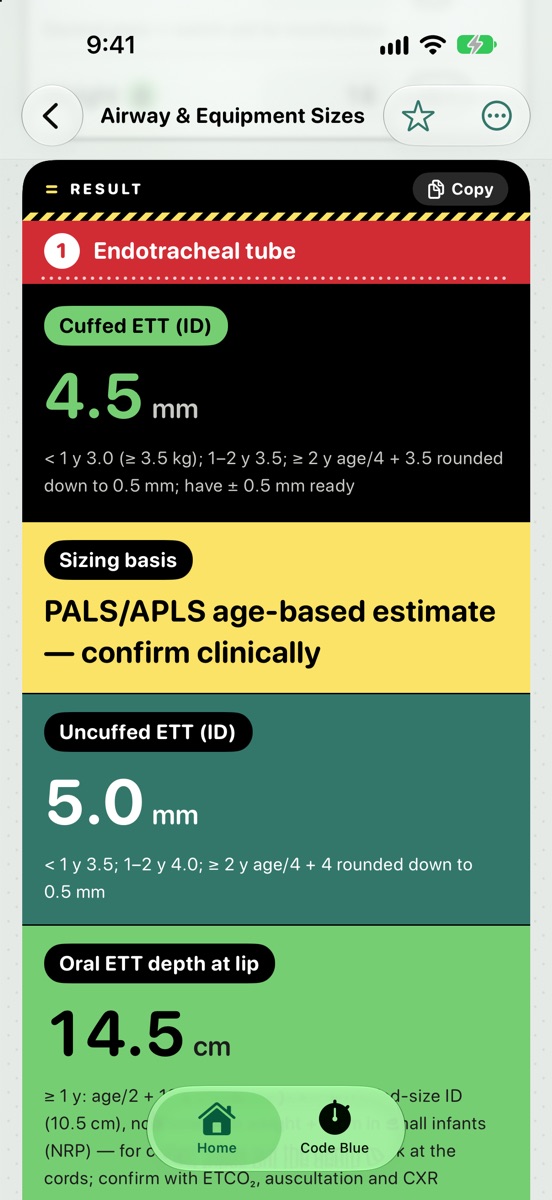
Cuffed ETTUncuffed 5.0 mm ·
14.5 cm at the lip
14.5 cm at the lip
4.5mm
Adrenaline IV/IO for arrest0.18mg 1.8mL
Shock36J
2nd shock: 72 J
Amiodarone for arrest90mg 1.8mL
50 mg/mL
Ketamine for RSI18mg 1.8mL
10 mg/mL
Code Blue
Run the code.
Run the code.
Keep the record.
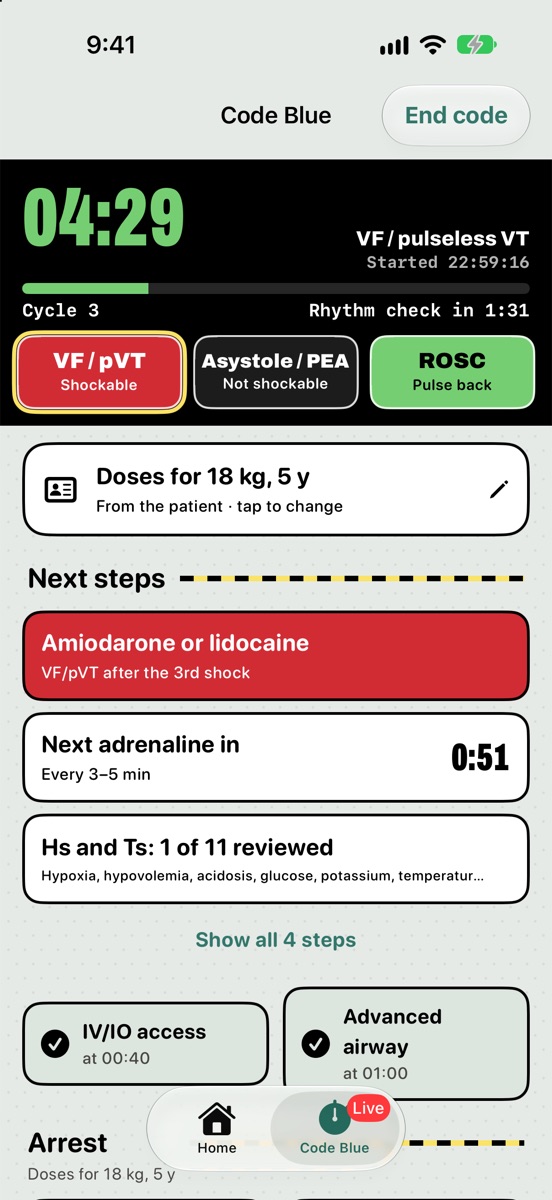
A stopwatch built for pediatric resuscitation, on its own tab. The monitor stays at the top and never moves under your finger.
- 2 MINAn alert at every rhythm check, in the monitor's own row, with the cycle counting down.
- ONE TAPEach drug or shock is logged with its time and the dose for the child. Undo is one tap.
- 3–5 MINA countdown to the next adrenaline, then due and overdue.
- PROMPTSShock energy steps, the antiarrhythmic after the third shock, the Hs and Ts.
- BLEEDINGRed cells, plasma, platelets, cryoprecipitate, tranexamic acid, factor VIIa and reversal agents.
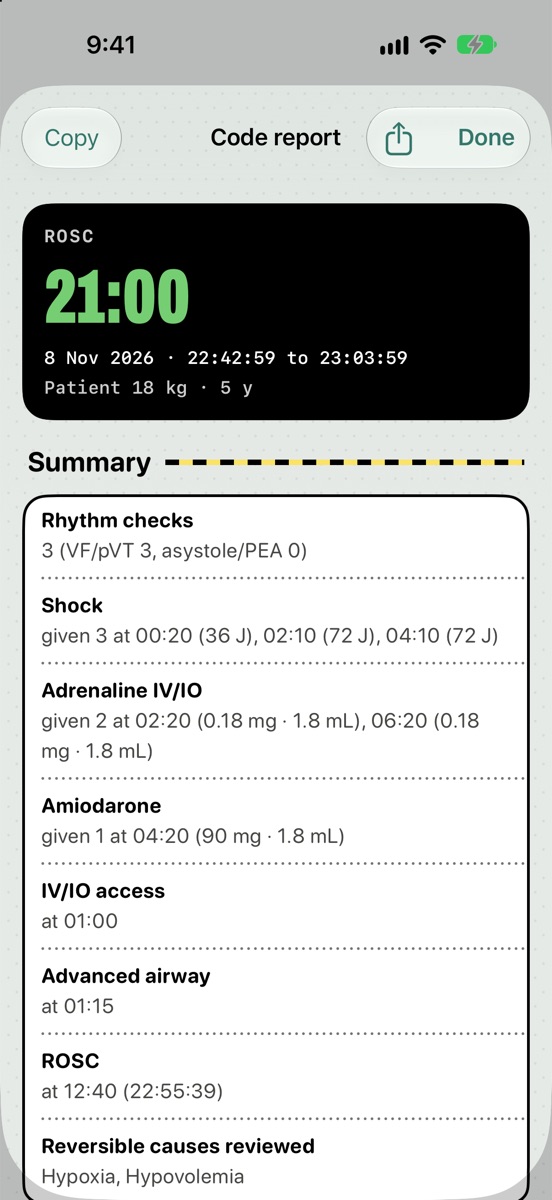
- REPORTWhen the code ends: every rhythm, shock and dose with its time, ready to copy into the notes.
04:29
VF / pulseless VTStarted 22:46:05
Cycle 3Rhythm check in 1:31
06:00 · rhythm check
VF / pVTShockable
Asystole / PEANot shockable
ROSCPulse back
Shock3
Subsequent shocks
72J
≥ 4 J/kg, up to 10 J/kg or the adult dose
02:34 ago
Adrenaline IV/IO2
0.18mg 1.8mL
IV/IO · 0.1 mg/mL (1:10 000)
00:26 ago next 2:34≡ RESULT Copy
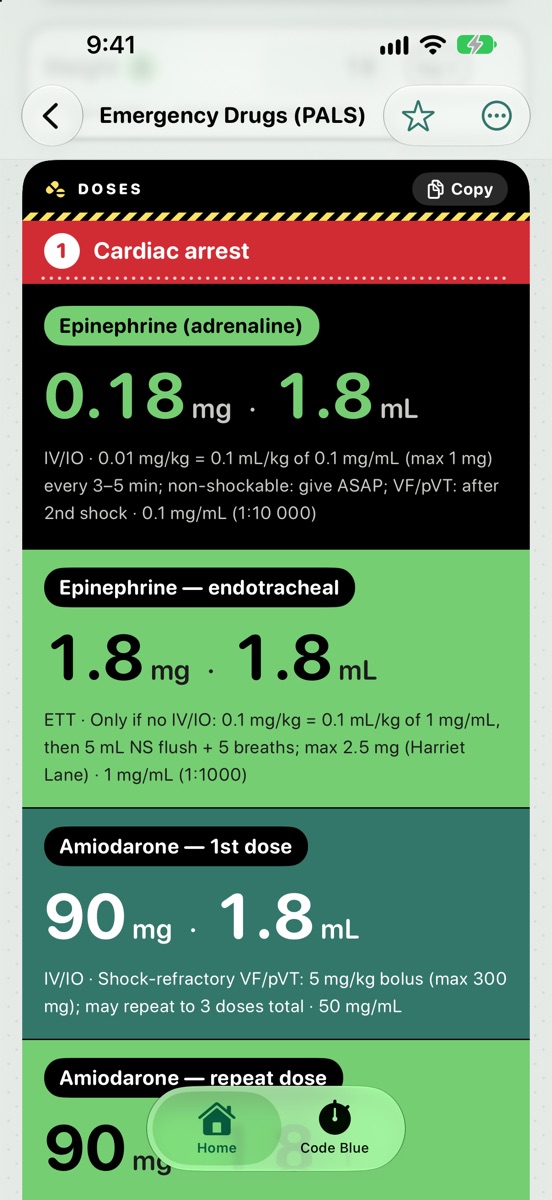
1Cardiac arrest
Epinephrine (adrenaline)
0.18mg· 1.8mL
IV/IO · 0.01 mg/kg = 0.1 mL/kg of 0.1 mg/mL (max 1 mg) every 3–5 min
Epinephrine — endotracheal
1.8mg· 1.8mL
ETT · only if no IV/IO: 0.1 mg/kg of 1 mg/mL, then a 5 mL saline flush
Amiodarone — 1st dose
90mg· 1.8mL
IV/IO · shock-refractory VF/pVT: 5 mg/kg (max 300 mg) · 50 mg/mL
Results
Readable from across the bed
Every result is a band: its name in a capsule, the value as large as the screen allows, and beneath it the rule, the concentration to draw up and the maximum.
Neighbouring bands never share a colour, and a dose held at its maximum wears a red capsule under its value. Copy puts the whole card on the clipboard.
Scores & criteria
The systems used on PICU rounds, each with its source
Severity and sepsis
- Phoenix sepsis criteria
- pSOFA
- PELOD-2
- PIM3
- Brighton PEWS
- Vasoactive-Inotropic Score
- Shock Index & SIPA
Respiratory
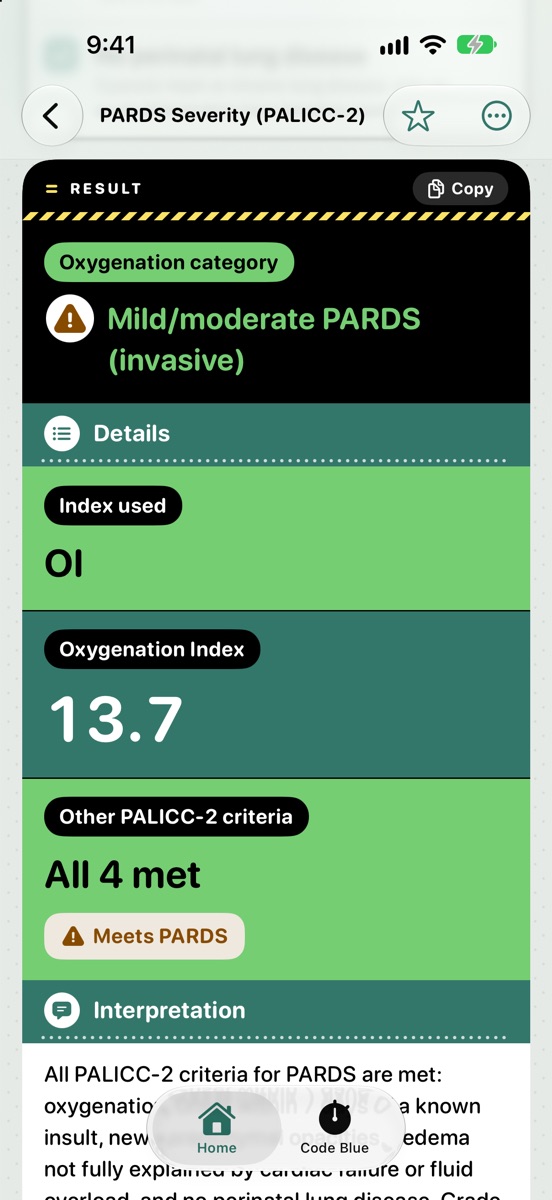
- PARDS by PALICC-2
- Oxygenation Index
- OSI
- P/F & S/F
- Westley croup
- PRAM
- PASS
- Wood–Downes
- Wang bronchiolitis
Neuro, sedation and delirium
- GCS child and infant
- FOUR
- COMFORT-B
- State Behavioral Scale
- RASS
- FLACC
- CAPD
- WAT-1
- SOS
- Brain death (2023)
Diagnostic criteria
- Kawasaki (AHA 2017)
- MIS-C (CDC 2023)
- HLH-2004
- Jones (AHA 2015)
- Anaphylaxis
- KDIGO & pRIFLE AKI
- ISTH DIC
- Cairo–Bishop TLS
- Toxic shock
Categories
Every category, one tap from Home
17ResuscitationArrest drugs, defibrillation, RSI, airway sizes
28RespiratoryOxygenation, PARDS, ventilator mechanics
22CardiovascularHemodynamics, O₂ delivery, vasoactive score
12InfusionsDrip rates, standard infusions, weaning
21Fluids & LytesMaintenance, sodium, osmolality, DKA
8RenaleGFR, AKI staging, urine indices
9Acid–BaseBlood gas, anion gap, compensation
22Neuro & SedationGCS, CPP, sedation and delirium scales
11ScoresPhoenix sepsis, pSOFA, PELOD-2, PIM3
7NutritionEnergy, protein, GIR, PN, BSA
13HematologyTransfusion, blood volume, ANC
In your pocket159tools, each with its formula, notes and references
Screens
From the app, on iPhone
Private by design
Nothing leaves the phone.
Patient values stay on the device and clear 12 hours after the last edit. Read the privacy policy.
- accounts or sign-in
- analytics, tracking or advertising
- network requests: every calculation is on the device
- names or identifiers asked for
CONTACT support@picucalc.com
Write to us
Questions, ideas, or a number that looks wrong.
Dose and content concerns come first. Tell us the calculator, the values you entered and the result you expected, with your source if you have one.
Never include a patient's name or any other identifier.
support@picucalc.com